Skip to content

Nelson bill linking principal evaluations to student peformance advances – Post Bulletin Story

By email hidden; JavaScript is required The Post-Bulletin, Rochester MN

ST. PAUL — A Rochester lawmaker’s bill requiring 35 percent of a principal’s evaluation to be based on student achievement won Senate approval on Monday.
The bill sponsored by Sen. Carla Nelson, R-Rochester, passed 55-6. The measure still needs to clear the House before it heads to the governor.
“Education accountability and reform advocates support an evaluation process for principals that is specifically tied to how well students are actually performing in academics,” Nelson said.
Last year, lawmakers passed legislation requiring 35 percent of teacher evaluations be based on student performance beginning in the 2014-15 school year. Lawmakers also passed a measure requiring principal evaluations, but it did not specify how much student achievement should factor into those evaluations. This new evaluation system would take effect in the 2013-2014 school year. This principal evaluation is among the requirements for the state receiving a waiver from the federal No Child Left Behind law.
Supporters say principals should be held to the same standards as teachers. Critics say it’s not fair to treat principals and teachers the same because they have different jobs.

Capitol Restoration proposed as part of the bonding bill – Heather J Carlson, Post Bulletin

Sen. Carla Nelson, R-Rochester, is sponsoring a bill to allocate state bonding money to repair the state’s crumbling Capitol building. In the House, Republicans are moving ahead with a $221 million proposal to restore and renovate the Capitol. Nelson plans to take a different approach. She wants to see a list of what needs to be done to maintain the structural integrity of the Capitol.
“I don’t think it’s necessarily the time to redo the whole inside of the building. I think you stop the damage, you keep the structure sound and then maybe at another time look at these things,” she said.  Nelson said she does not know yet what it will cost to do essential repairs.

Sen. Carla Nelson: Investment in education and job growth will sustain Minnesota’s prosperity

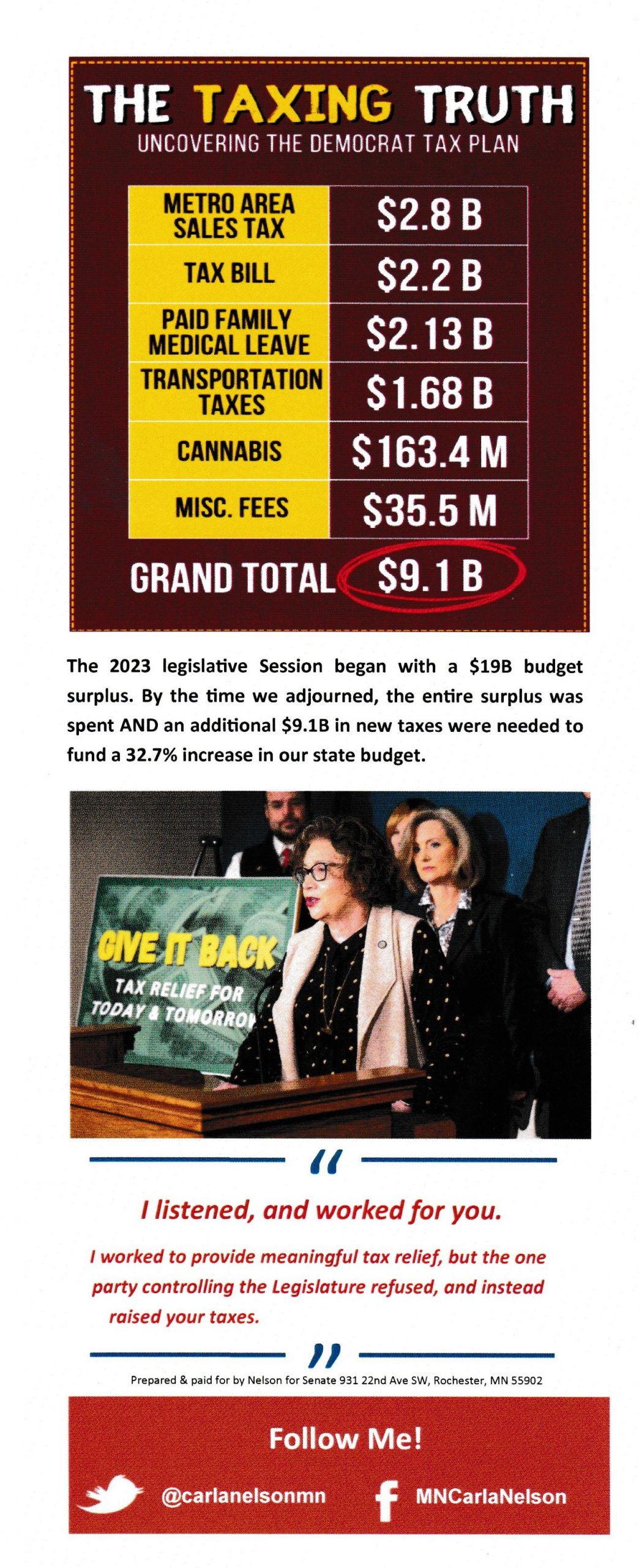
What a difference a year makes.  Recently, a $323 million surplus was announced by the Commissioner of Management and Budget. This surplus is on top of the $876 million surplus announced last November.
This gives Minnesota great hope and shows that legislators have made good and prudent decisions in managing the state’s budget this past year.
By law enacted last year, the budget surplus will first fill up the cash flow account and then completely fill the budget reserve. That’s like the money in your checking account and your savings account. We will also be able to begin to pay back the delayed monies to our schools early.
It is important to not only have short-term goals, but to wisely be able to look to Minnesota’s future.  While many factors contribute to sustained prosperity in our state, I am focused on educating our work force and improving our jobs climate. Those two factors contribute to private sector job growth, which is key to Minnesota’s economic success.

Educating our work force
Last week, Governor Mark Dayton signed my bill (SF 1213) into law, giving Minnesotans, at the state and local levels, an improved ability to evaluate the effectiveness of our Adult Basic Education program. We currently measure its effectiveness by tracking a few different outcomes for program participants.  The modification in my bill adds a new outcome to track: Are they independent?  This ensures tax dollars are being used effectively by allowing us to finely tune our programming and support individuals in their quest to live independent of government assistance, thrive in their career and prosper in their community as a whole.  My digital learning bill (SF 1528) was passed by a committee of the whole in the Senate last week. This bill harnesses the power of new technology and innovation, creating a one-stop, online shop for teachers seeking out digital learning content that is aligned with Minnesota standards. Furthermore, it instructs the Online Learning Advisory Council to evaluate existing state rules and regulations and identify those that prevent teachers and students from accessing high quality digital learning tools.
Preparing our children to be successful in today’s complex, technological world is no small task. As a public school teacher, I know that. We can start today by allowing space for more innovation in our classrooms.

Improving our jobs climate
I have heard from job creators in our district that had great ideas but were unable to secure funds for their ventures or hit a dead end when faced with an inefficient permitting process.  Their concerns were the catalyst for two of the jobs bills I have introduced this session. One bill (SF 2355) helps job providers in our region by enhancing the Angel Investor tax credit, providing a 50 percent individual income tax credit to those who invest in greater Minnesota businesses.  Our region has been ranked countless times as a great place to live, work and raise a family, and has the potential to grow 10,000 jobs over the next ten years. We know that investing in Rochester and Olmsted County provides a good return on investment for the State of Minnesota. This bill, if signed into law, would send a clear message that directing start-up funding to our job creators provides a good return on investment for investors as well.  Job creators looking to establish or expand businesses face a sometimes overwhelming number of obstacles in our permitting process. I’ve authored another jobs bill (SF 1957) to ease the process for businesses seeking permits involving more than one state or federal agency. My bill identifies the primary agency, from all the agencies involved, to manage and coordinate the business’ request. That primary agency would be responsible for developing and providing the business with a timeline, act as the central point of contact for the business and make permit applications and supporting documents available online. This streamlined approach will allow job providers more time to do what they do best: create jobs.
It was Oliver Wendell Holmes who once said: “It is not so important where you stand, as in what direction you are going.”
That being said, Minnesota is obviously heading in the right direction for governing with good, prudent fiscal management. Having a budget surplus allows lawmakers the opportunity to move forward on many agendas — like education and job growth — in the best interest of the state. Our future is bright and I am committed to staying the course and providing the leadership necessary to ensure sustainable prosperity for Minnesota.

Expansion of Critical Care Access Bills Pass the Committee Health and Human Services

This week, two critical care access dental bills that I sponsored along with Rep. Kim Norton (D)  were heard before the Senate Committee on Health and Human Services. These bills, SF 1626 and SF 2143, answer a lack of critical access to dental care.

Both bills came from collaborations with Good Samaritan and Apple Tree dental providers, along with Hiawatha Homes. The bills seek to provide needed dental care for those with disabilities in group homes. The bills will be considered for possible inclusion in an ombudsman health bill and it is my sincere hope that they are included.